Architecture and Cognition: The Artificial Intelligence of VossBridge
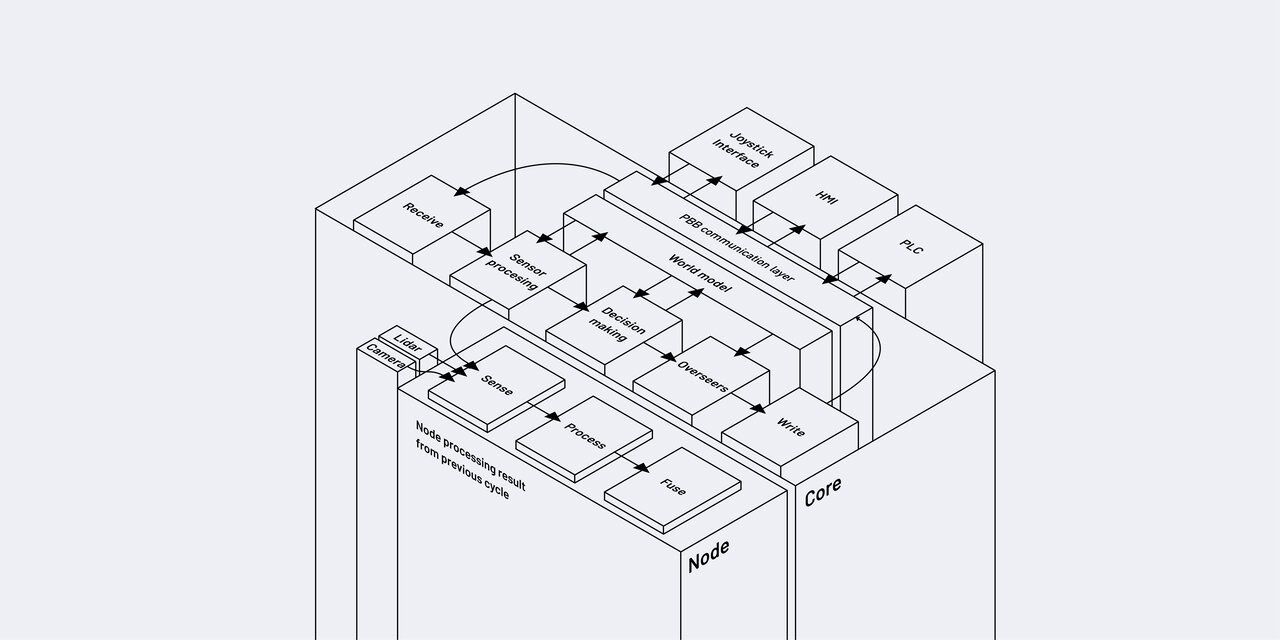
Architecture:
Perception – Planning – Action
The system's real-time architecture is based on a proven three-stage principle. First, the system fuses the LiDAR and camera data streams into a statistically optimized estimate of the aircraft's position and orientation, as well as the reliable identification of the aircraft type. VossBridge processes even noisy or incomplete data with absolute stability. Next, the system determines the optimal and safe path to the detected door position. From a distance of approximately 2–3 meters, the sensor-controlled AI takes over the fine control while existing safety mechanisms remain active. Finally, the system translates the optimal path into control commands for the mechanical and hydraulic drive systems, which are continuously monitored and adjusted via real-time sensor feedback.
Since safety on the apron is the top priority at all times, the bridge's autonomous approach fundamentally only begins once the aircraft has reached its final parking position and is completely stationary.
The Cognitive Approach:
Belief-Desire-Intent
The cognitive software architecture of VossBridge follows the established Belief-Desire-Intent (BDI) approach to dynamically control complex decision-making processes.
Belief (Knowledge & World Model): VossBridge features a central, predictive world model in which knowledge about the system's own state and the environment is collected, filtered, integrated, and continuously updated (predicted) in a coherent form.
Desire (Goal Level): A higher-level deliberative layer makes fundamental decisions regarding the goal currently to be pursued. The AI core of VossBridge breaks down the main goal into logical intermediate steps and ultimately into concrete actions—right down to the control commands for the individual axes of the passenger boarding bridge. This part of the decision-making and control is implemented based on a hierarchical, behavior-based architecture.
Intent (Intent & Implementation): Individual behaviors of VossBridge have specific preconditions, constraints, and postconditions. These are recursively nested into complex strategies and utilize only two different arbitration methods: priority lists and sequences. Taking into account the current sub-goal, the state in the world model, and the framework conditions, these methods select the individual behavior currently to be executed. The selected behavior then calculates the specific control command that is sent to the passenger boarding bridge.
Explore the Autonomous Passenger Boarding Bridge at the Airport
See the precision of VossBridge's door detection and the seamless docking process of our autonomous PBB yourself. Contact us to arrange a live demonstration or an initial feasibility analysis for your specific bridge inventory.